
Enter the SPA Regional Awards 2027!
9 November 2026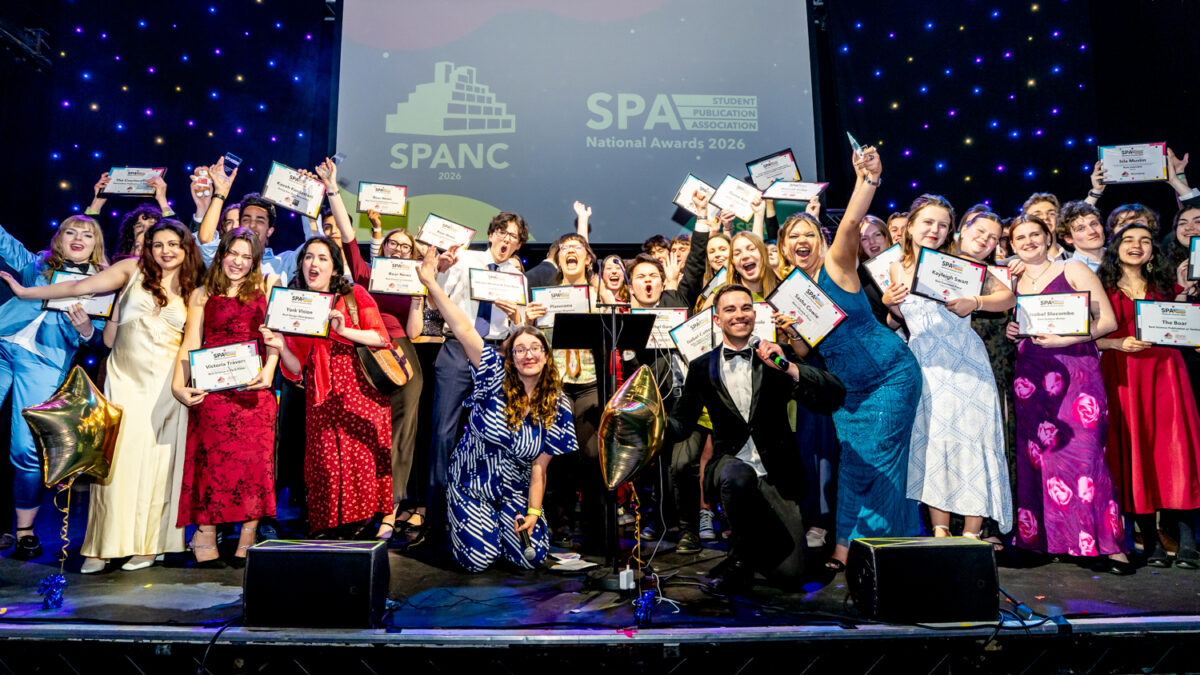
Planning for #SPANC27? How to ask your university or students’ union for funding
It’s never too early to ask your university or students’ union to help pay for #SPANC27 – even though the host, dates and ticket prices are yet to be announced.
Funding decisions often take time, and a request made this semester could make the difference between attending the Student Publication Association’s National Conference and missing out.
The SPA is encouraging editors, student media committees and individual journalists to approach their institutions now to ask for support in principle, with exact costs to follow once arrangements for 2027 are confirmed.
From the SPA’s 2026 Membership Survey
70 of 85responding publications said their publisher had never funded members to attend an SPA event.
71 of 85responding publications said their publication had never funded attendance itself.
We want to help change that!
Why is SPANC worth funding?
SPANC brings student journalists together from across the UK and Ireland for a weekend of practical training, professional advice, networking and the SPA National Awards.
For universities and students’ unions, supporting attendance is an investment in students’ employability, the skills of their media teams and the quality of student journalism on campus.
And the conference is not only for students who intend to become full-time journalists. Running a student publication develops transferable skills - research, writing, editing, verification, digital production, teamwork, project management and leadership - which are useful in many careers.
At SPANC26 in Norwich, the conference programme had more than 20 panel discussions and keynote events, practical workshops, one-to-one sessions with working journalists and networking opportunities.
We also run one-to-one copy clinics, CV feedback, portfolio advice and professional byline photographs.
What a student can gain
- Practical skills: learn from professional journalists about reporting, editing, interviews, investigations, digital storytelling and the realities of working in the media; discuss ideas that can be used immediately back at the publication.
- Career development: meet working journalists, get advice on applications and portfolios, learn what employers look for and make contacts for future opportunities. No conference can guarantee a job, but access to experienced professionals can help students make more informed decisions.
- Confidence and connections: meet student journalists from other universities, compare approaches to shared challenges, make friends and develop a network beyond campus.
- Leadership: learn how other teams manage deadlines, support contributors, tackle difficult editorial decisions and hand over a publication to the next year's editors.
- A voice in the sector: take part in the SPA's democratic processes, including the AGM and elections, helping shape the support offered to student journalists in future.
What is in it for the university or students’ union?
A well-prepared request should explain the benefit to the institution as well as to the person travelling.
Even a small delegation can bring back learning to share with dozens of contributors, so the value of the funding need not stop with the attendees.
- Employability and student development: students gain experience of professional training, networking, public speaking, collaboration and taking responsibility outside their degree.
- Stronger student media: reporting and editing training can improve the standard and reliability of campus journalism; new editors can learn from peers at other publications.
- Fairer access: financial support allows students who cannot afford the weekend themselves to take part, rather than restricting a valuable opportunity to those with spare money.
- Recognising student achievement: the SPA National Awards celebrate individual work and whole publications, giving student journalists an opportunity for independent professional recognition.
- A tangible return: funded delegates could run a skills session, prepare a written report, update a publication's handbook or mentor other contributors after returning.
Universities and students’ unions can be proud of their publications’ achievements while respecting their editorial independence.
The national awards are part of the weekend
SPANC also hosts the SPA National Awards, which recognise the best student reporting, investigations, interviews, specialist coverage, photography, design, publications and more.
The 2026 National Awards attracted 1,404 entries and were judged by journalists and editors from major UK news organisations. Recognition should be a source of pride for their universities and unions.
Our awards are free to enter, and students do not need to buy a conference ticket to submit an entry or win but funding attendance enables them to be there in person.
What does the ticket include - and why does it cost what it does?
We know the cost of a weekend away is significant for students. Accommodation, transport and tickets can put SPANC beyond the reach of people on a tight budget.
That is precisely why the SPA spends much of the year securing sponsorship and other support, rather than passing the full cost of the event to delegates.
Our conference-and-awards packages include many costs that would otherwise need separate funding: a Friday welcome event, a weekend of journalism sessions and workshops, networking opportunities, meals, and a place at the national awards ceremony and dinner.
Accommodated packages have generally included two nights in a shared twin hotel room, often with breakfast, and we negotiate group rates to keep costs as low as possible.
Exactly what a #SPANC27 ticket includes will be confirmed with the host and the final programme.
What have tickets cost in previous years?
We’re in the process of picking our #SPANC27 hosts, which will affect ticket costs. These published prices from previous years are planning references. Prices for #SPANC27 have yet to be announced.
| Year and host | Conference and awards, no room | Full weekend with shared accommodation |
|---|---|---|
| 2024 — Bristol | £75 | £170 |
| 2025 — Exeter | £90 | £170 |
| 2026 — Norwich | £80 | £162 |
Across those three years we’ve tried to limit rises even amid rising inflation and costs.
How sponsorship keeps tickets lower
SPANC is organised completely by volunteers and we seek support from universities, publishers, journalism bodies and other partners to meet the substantial cost of venues, speakers’ travel, meals, awards, production and accommodation. Our speakers also generously give their time for free.
The aim is to keep student tickets as affordable as possible without removing the parts of the weekend that make it worthwhile.
To put into perspective, we need to bring in at least £100 of sponsorship per planned attendee or we would have to raise more from tickets, make cuts to the programme or find funding elsewhere.
How much should you ask for?
Coach travel or a local venue could bring that down; long-distance travel, travel from Ireland or particular accessibility requirements could raise it.
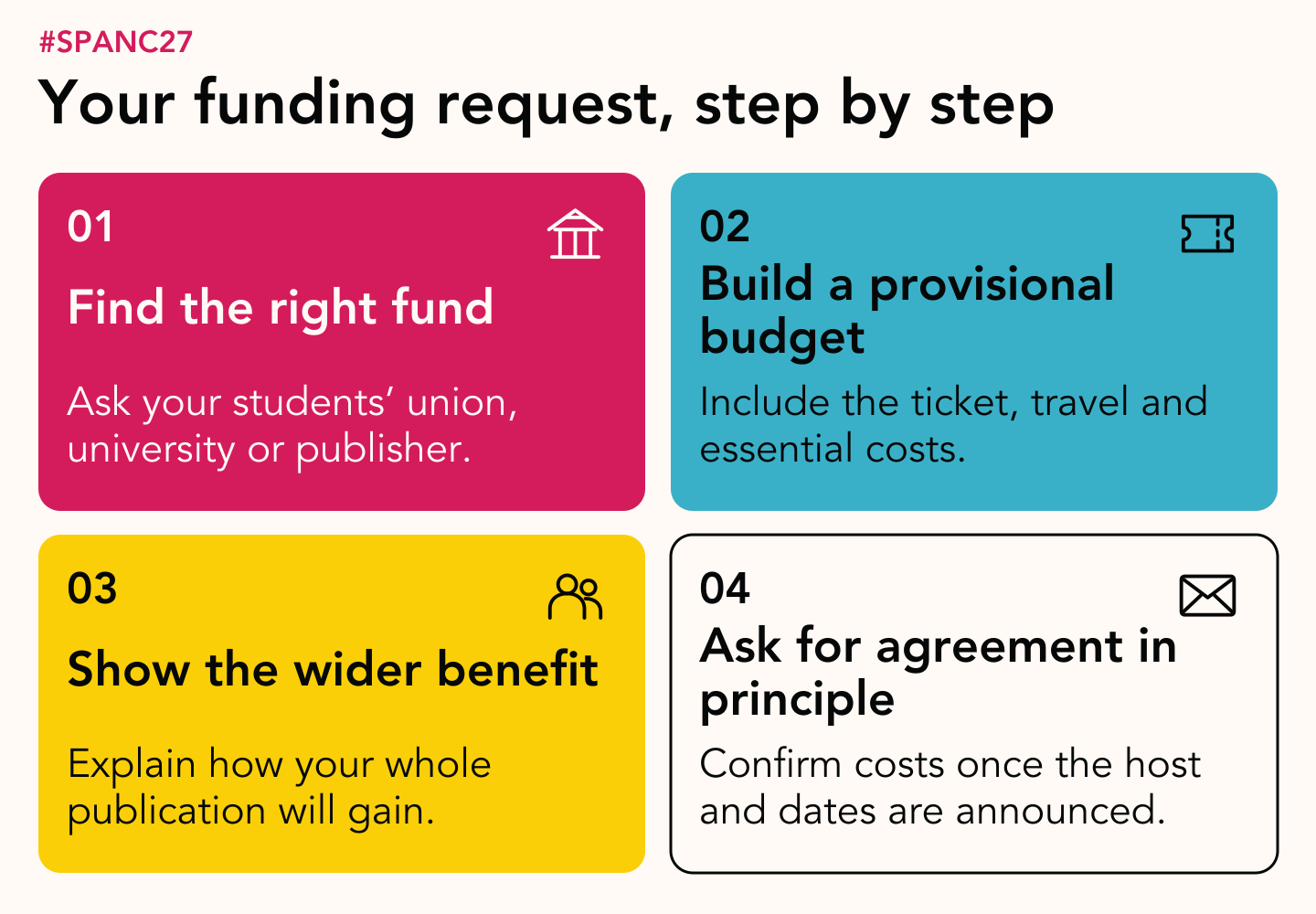
A funding request can give an estimate and seek approval in principle, rather than ask for a payment before the details are known.
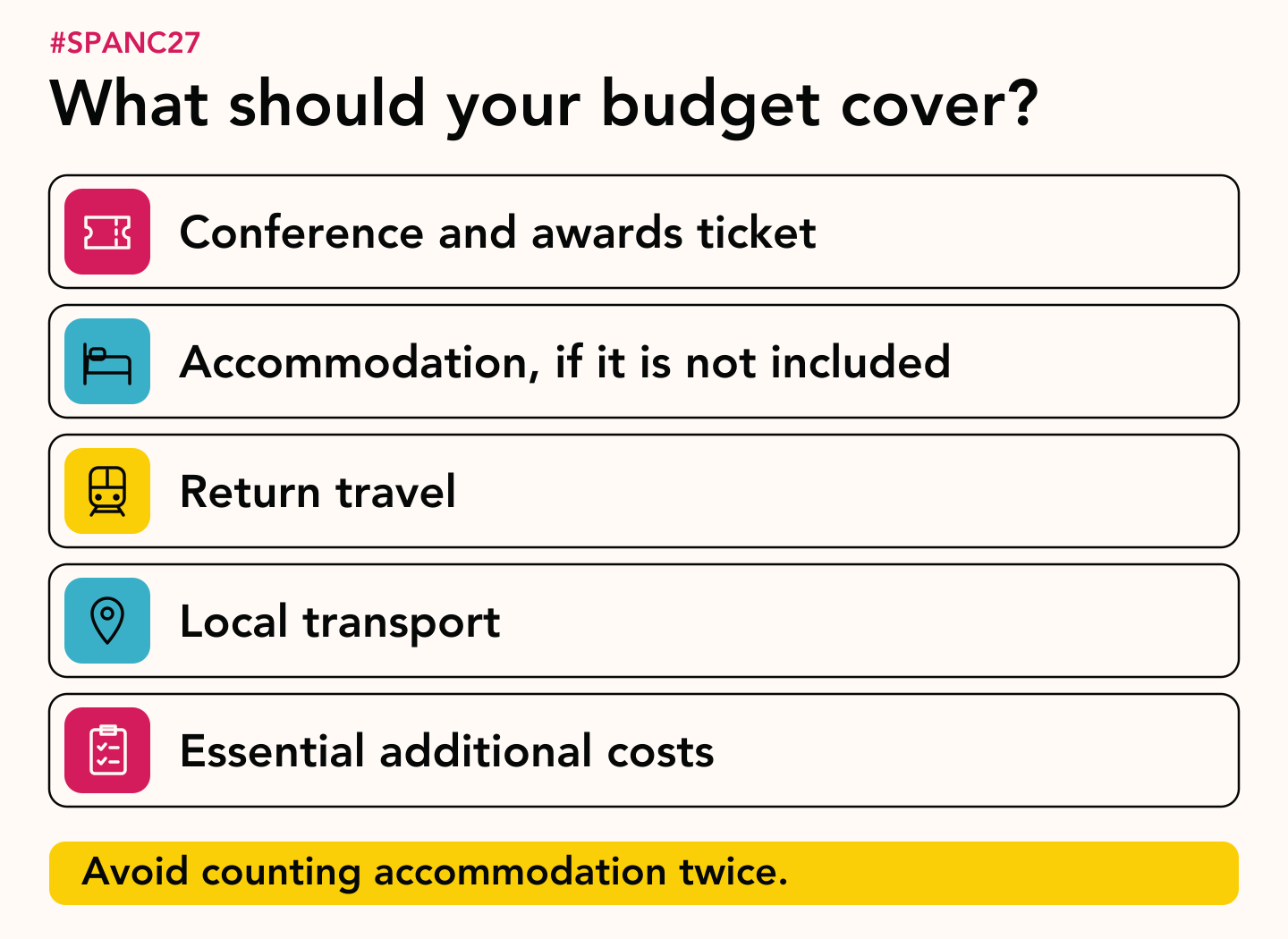
Include the conference ticket, accommodation if it is not included, return travel, local transport and any essential additional expenses. Don’t rule out the idea of partial funding which could bring the per-person cost down for your members!
Who should you contact?
Your students’ union
Ask your societies or student activities team, finance committee or elected officers about conference, training, society-development or travel funding.
Your publication’s publisher
If your newspaper or magazine is supported by a students’ union or university, ask whether editorial training or professional-development money is available, even if it comes from a different budget.
Your university
Journalism and media departments, careers and employability services, student experience teams, fundraising teams, and alumni offices may have relevant support.
Other supporters
Ask whether your publication has an alumni fund, existing partner or a modest training budget which could cover some of the cost without affecting editorial independence. Or approach your local newspaper or local business to see if they’ll support you.
Schemes vary considerably and some funds we’re aware of are only for registered societies; some can be used only for particular kinds of events; others will not cover retrospective spending.
For example, Sheffield Students’ Union’s Events Fund includes conferences among eligible activities for its recognised societies, while Students’ Union UCL sets its own application conditions and grant limits.
Do not wait for the ticket announcement just to find out the rules.
Ask who can submit a request, when decisions are made and whether funding can be reserved for an event whose final costs are still being agreed. If your publication is not an affiliated society, ask about alternative university or publisher budgets rather than assuming you are ineligible for all support.
How to keep travel costs down
Transport can make a big difference to the final bill - and the cheapest option is not always the train. Once the host city and dates are announced, compare several ways of getting there before committing to a ticket.
- Check coaches and long-distance buses first: compare routes and fares with National Express and FlixBus. A coach may take longer but can be substantially cheaper than rail on some routes. Compare the full journey, including changes and travel from the stop to the venue.
- Look for student coach discounts: National Express currently advertises eligible student discounts through UNiDAYS, Student Beans and TOTUM, including a weekend offer subject to terms. Its Young Persons Coachcard can offer another saving on qualifying fares, but check the card’s own price and whether it is worthwhile for your journey.
- Compare rail offers: book in advance where practical, check any eligible Railcard, and look at National Rail GroupSave if three to nine people can travel together on a qualifying off-peak journey. GroupSave and Railcard discounts generally cannot be combined. The SPA has also secured event-specific travel deals in previous years, including a GWR train discount for SPANC25 and a similar deal with Greater Anglia for SPANC26. We can’t guarantee this will be available again this year, but we will always try!
- Ask about group or university travel: students’ unions may have booking arrangements or a minibus; publications travelling together could share suitable transport costs. Only do so where safety, insurance, accessibility and institutional policies allow.
- If travelling from further afield: compare relevant coach, rail, ferry and flight combinations once the host is known (domestic or short flights can be surprisingly affordable). Do not assume the most obvious route is the cheapest!
If you are requesting institutional funding, showing that you compared a coach with a train and considered discounts demonstrates careful use of the university’s or students’ union’s money.
Leave enough time for the conference programme, and check accessibility and journey times as well as the fare.
What makes a good application?
The best case is not simply that your members would enjoy the weekend (although we guarantee you will!)
Explain what your university, students’ union and wider publication will get back from supporting a delegation. Specify what the attendees want to learn, why those skills matter and how they will share the benefit with others.

Sharing publications and ideas at #SPANC25.
Name the learning outcomes
For example, stronger investigation techniques, better interviewing and editing, multimedia skills, safer and more accurate reporting, or careers advice.
Show the wider impact
Promise a workshop for contributors, a training article, a new handover guide or mentoring for next year’s editors. A report on the sessions attended can help the funder see what the contribution achieved.
- Mention the awards: recognition for a student journalist or publication could enhance the institution’s reputation.
- Give a sensible budget: explain how you arrived at the estimated ticket price, compare travel choices and state whether any member or publication contribution is possible.
- Ask early: find the funding deadline and request agreement in principle while the host and final price are being confirmed.
- Offer to promote support: explain how you would acknowledge the institution’s support and show how its funding improved the student experience.
If the institution is reluctant to support a whole team, propose one or two funded places, a contribution towards travel, or a modest amount to be topped up from another budget. Any funding should be agreed before non-refundable travel or tickets are bought.
Template: ask your university or students’ union for support
Copy and adapt this request to your publication. It deliberately asks for agreement in principle because the 2027 host and final costs are not yet known.
Subject: Request for funding in principle — SPA National Conference 2027
Hello [name],
I’m writing on behalf of [publication], the student-run [newspaper/magazine/journal] at [university]. We would like to ask whether [students’ union/university/department] could support members of our team to attend the Student Publication Association’s National Conference, #SPANC27, in 2027.
SPANC is a national training and networking weekend for student journalists across the UK and Ireland. Previous events have included workshops on reporting and editing, advice from working journalists, CV and portfolio support, and opportunities to meet students from other publications. The conference also hosts the SPA National Awards, which recognise outstanding student journalism.
We believe this would be a worthwhile investment in students’ professional development and in the quality of our publication. The delegates would gain practical skills, industry insight and contacts, and we would share those benefits with our other contributors. Following the event we would [deliver a training workshop/update our editorial handbook/mentor new reporters/share a written report] so that the support benefits our wider membership.
The host, dates and final prices for #SPANC27 have not yet been announced. Comparable shared-accommodation packages in recent years have been budgeted at around £170 per person before travel, and we propose allowing approximately £[amount] per delegate for the ticket, return transport and any essential costs. We will compare coach and rail options and supply a confirmed, itemised budget as soon as the details are published.
Could we seek agreement in principle or have an amount reserved from [professional development/student experience/society] funding? If it is not possible to support the whole delegation, we would welcome a contribution to one place or towards travel costs. Please could you let us know the appropriate process, the next application deadline and any evidence you need?
Many thanks,
[Name]
[Role, publication and contact details]
What if funding is refused?
Ask whether there is another fund or a different decision-maker, whether a smaller contribution could be considered, or whether one place could be supported instead of a larger delegation. If your university has already committed its budget for this term, find out when the next allocation opens. Early discussions may still help you secure funding for 2027.
The SPA also runs a separate Financial Assistance Scheme (FAS), which in previous years has supported eligible students who could not otherwise afford to attend, covering tickets, accommodation and travel. However, spots on the scheme are very limited and will depend on how much sponsorship we can bring in this year. The linked guidance describes the 2026 scheme.
Start the conversation now
You do not need a confirmed #SPANC27 ticket to ask about next year’s training budget.
Find the person who makes the decision, establish the deadline and request support in principle. We will publish the host, dates and confirmed prices when they are agreed.
For help making the case for funding to your university or students’ union, contact representation@spajournalism.com and advocacy@spajournalism.com. For general SPANC enquiries, contact events@spajournalism.com. You can also read the SPA’s latest research into the financial pressures facing student publications.